Everyone Tells You to Tell Stories. Here's How to Actually Do It.
How to turn your life experiences into stories people actually want to hear.
We hear all the time that storytelling is one of the most effective forms of marketing. That if you want to connect with people online, you need to tell more stories. Share your experiences. Let people get to know you. Make your content more personal.
And while I agree with all of that, I think we've gotten into the habit of using storytelling as this blanket term without ever really explaining what it means.
I work with people every day who have incredible stories to tell. They've had interesting careers, made difficult decisions, overcome challenges, and experienced things that other people would find fascinating. But when it comes time to actually share those experiences, they often don't know where to begin.
Which part of the story is worth telling? How far back do you need to go? What details should you include? And how do you take something that happened over the course of several months, or even several years, and turn it into a story that someone can follow in a two-minute video or an Instagram carousel?
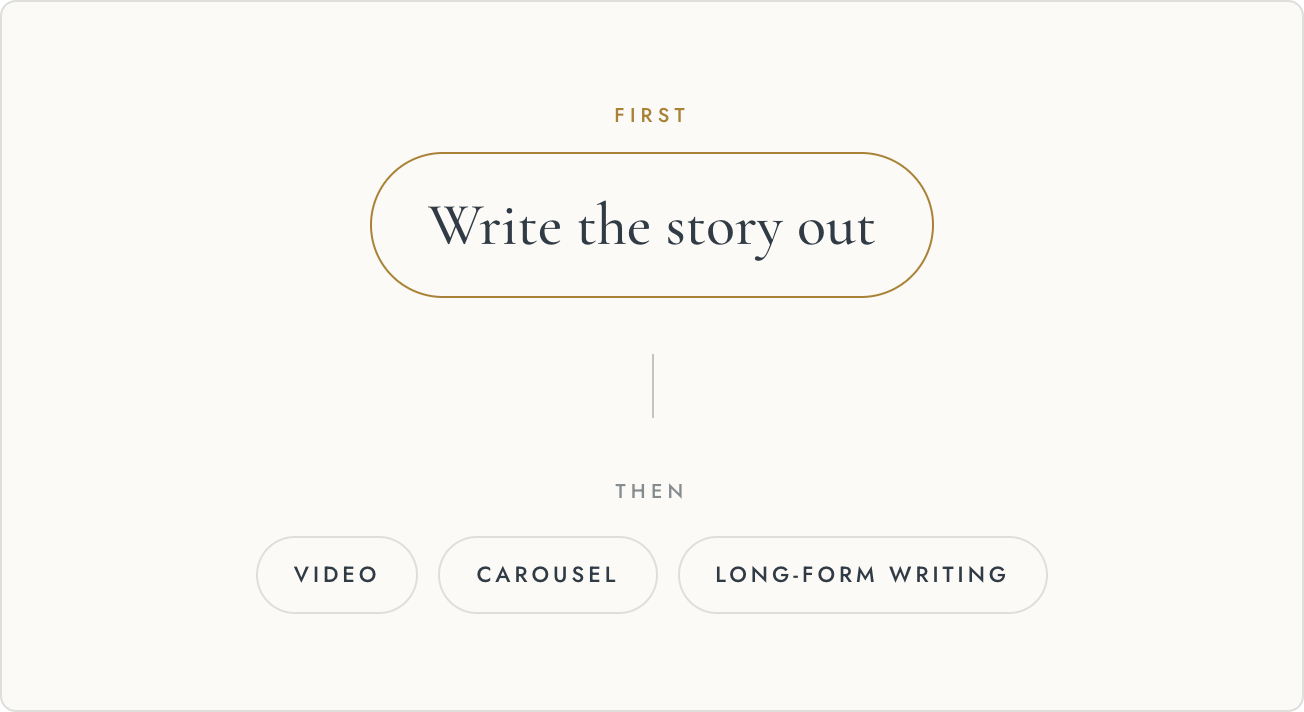
These are the questions I help my clients work through all the time. And what I've found is that the challenge usually isn't the format. It's figuring out how to organize the experience into a story in the first place. That's why, regardless of whether we're creating a video, an Instagram carousel, or a longer piece of writing, I almost always encourage my clients to start by writing the story out. Before we think about how to film it or what photos to use, we need to figure out what actually happened, which details matter, and how to walk someone through those events in a way they can follow.
And I think the answer is much simpler than people realize.
Start with the basic building blocks.
When I'm teaching someone how to tell a story, one of the things I encourage them to do is imagine their audience as a classroom of fifth graders.
I don't mean that your audience is unintelligent! I mean that when we're consuming content online, we're not necessarily giving it our full attention. We're scrolling through Instagram, watching videos between meetings, or reading something while we're doing three other things. We need information presented in a way that's incredibly easy to follow.
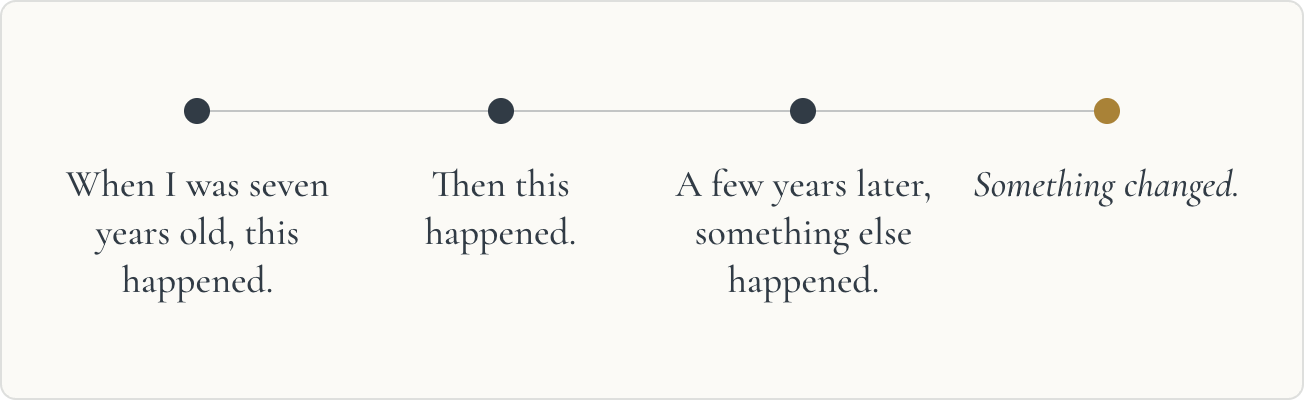
And so I encourage my clients to think about storytelling at its most basic level. When I was seven years old, this happened. → Then this happened. → A few years later, something else happened. → And as a result of those experiences, something changed.
That's the foundation of a story.
Of course, there's room for nuance and creativity, but before we get to any of that, we need to make sure we can walk someone through a sequence of events without losing them along the way.
Remember, at the end of the day, a story is simply series of events that helps us understand how one thing led to another, and why it mattered.
1. Start somewhere specific.
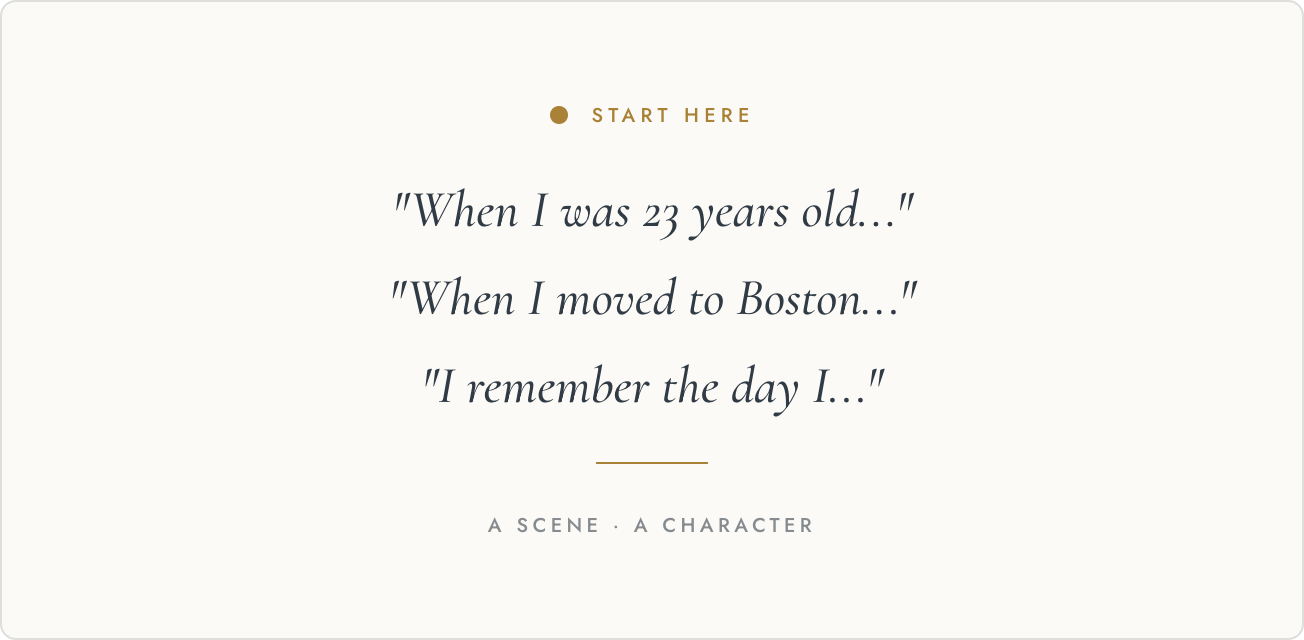
One of the easiest ways to begin a story is to tell us how old you were when something happened. "When I was 23 years old..." or "When I was in college..." or "When I moved to Boston..." You can also begin with a specific moment or memory, like "I remember the day I..." or "The first time I ever..."
These are simple openings, but they're effective because they immediately give your audience a place to begin.
Recently, I was working with a client who was trying to tell a story about her unconventional education and the challenges she experienced later in her career because of it. Initially, she was explaining the experience to me. She was telling me about being homeschooled, not having a traditional education, and eventually needing to teach herself things she hadn't learned growing up.
All interesting information, but I wanted her to take me back to the beginning. I asked her what her education actually looked like when she was a child.
She told me that when she was ten or eleven years old, her parents would leave a stack of schoolbooks on the kitchen table and tell her they'd be home by three.
I stopped her right there. That's where your story begins.
Because now I can picture it. I can imagine this little girl sitting at her kitchen table, a stack of books in front of her, trying to get through her schoolwork before her parents return. We have a scene. We have a character. And naturally, I want to know what happens next.
You don't need to begin with a profound statement or explain why the story matters. Just give us somewhere to start.
2. Tell us what you wanted.
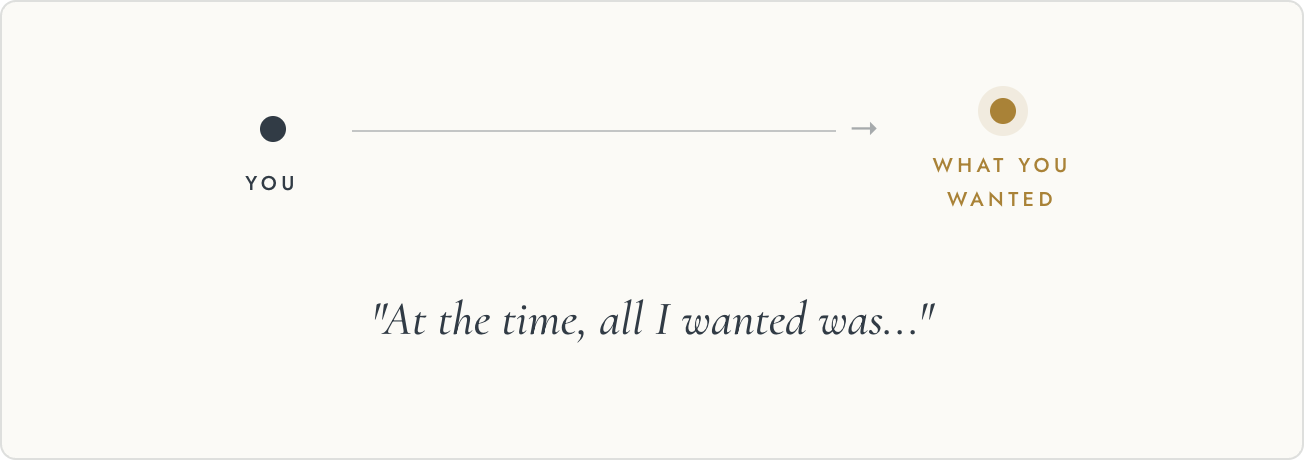
Once you've established where the story begins, help us understand what mattered to you at the time. What were you trying to accomplish? What did you want your life to look like? What were you working toward?
Maybe you wanted to move to a new city. Maybe you wanted to become a writer. Maybe you wanted to get into college or leave a job you hated. You can introduce this part of the story with incredibly simple language, like "At the time, all I wanted was..." or "My dream was to..." or "I was determined to..."
In my client's story, she wanted to finish her schoolwork as quickly as possible so she could spend the rest of the day doing what she enjoyed. As she got older, she became serious about studying the violin. Her dream was to attend a music conservatory, and she believed that if she could perform well enough, the rest of her education wouldn't matter.
Now we understand something important about the person we're following. We know what she wanted, and we can begin to understand why she made the decisions she did.
3. Tell us what got in the way.
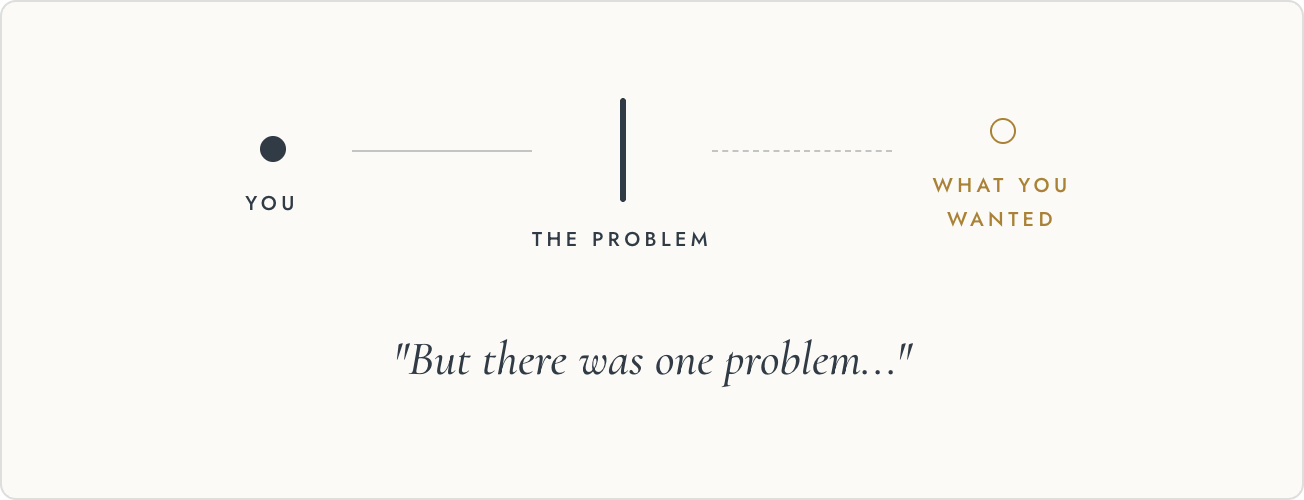
This is where we introduce the problem. Something happens that makes it difficult for you to get what you want. Maybe you encounter an unexpected obstacle. Maybe someone tells you no. Maybe you realize that something you believed about yourself or the world isn't actually true.
A few simple ways to introduce this part of the story are "But there was one problem..." or "What I didn't realize was..." or "Everything was going according to plan until..."
In my client's case, she had spent years getting through her schoolwork by copying answers from the back of her textbooks. She was focused on practicing the violin and didn't think a traditional education was particularly important. But then she realized she needed a GED to attend college. And suddenly, all those subjects she hadn't properly learned mattered a great deal.
That's the turning point. We understand what she wants, and now we understand what's standing in her way.
4. Walk us through what happened next.
This is the part of storytelling where I see people struggle the most. They skip over things that might seem obvious to them because they already know how the story ends.
But your audience doesn't know how the story ends.
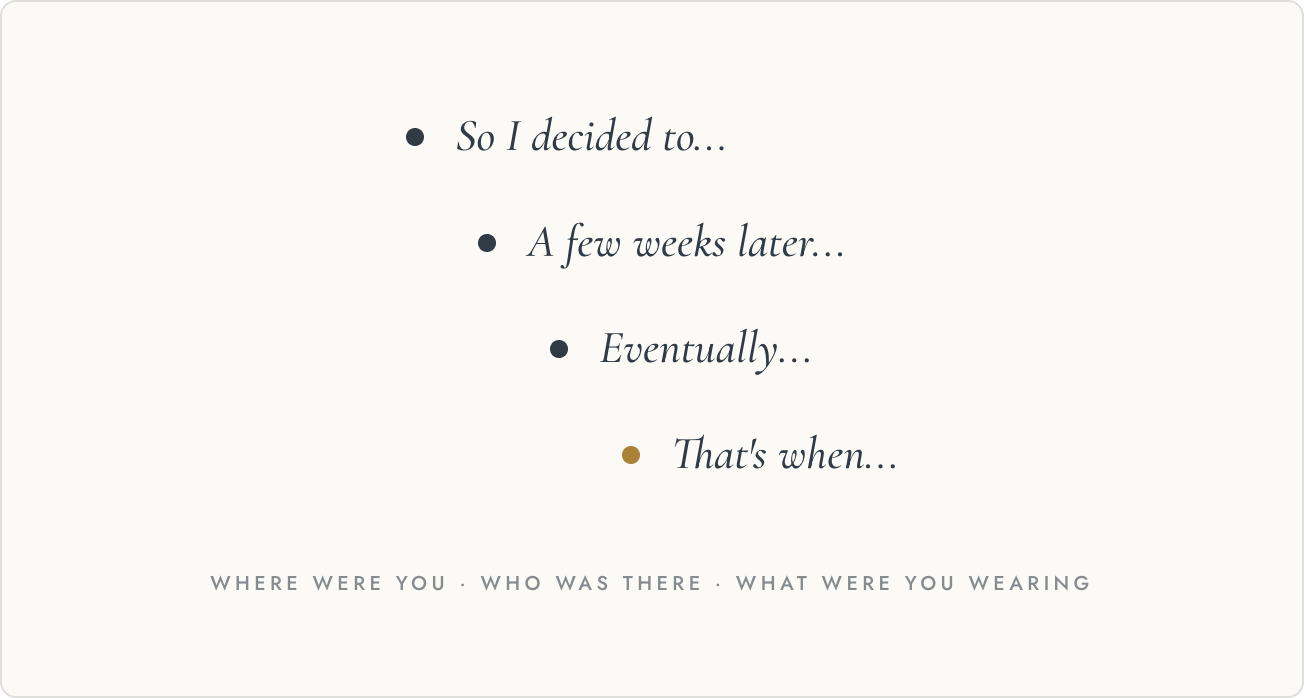
And this is why it's so important to walk people through the events in an order they can understand. You can use simple phrases like "So I decided to..." or "A few weeks later..." or "Eventually..." or "That's when..." These little transitions are incredibly useful because they help move the story forward without making your audience work to figure out what happened between one event and the next.
In my client's story, she began studying for her GED with her father, who would come home after long shifts at the restaurant and sit with her at the kitchen table, trying to help her understand algebra and all the other subjects she'd missed.
Eventually, it was time to take the test. She remembered being dropped off at a high school, somewhere she wasn't used to being, wearing a skirt and blouse and feeling completely out of place among the other students.
When she told me that detail, I encouraged her to include it. Because that's the kind of thing that makes a story come alive. Rather than telling us, "I was nervous to take my GED," she's allowing us to picture what that experience was actually like.
As you're writing, think about the details that would help someone imagine being there with you. Where were you? Who was there? What were you wearing? What did someone say? What were you thinking?
You don't need to include every single detail, but you do need to give people enough information to understand and picture what happened. Give yourself permission to let the story unfold. You don't need to rush through everything to get to the point. Sometimes the little details are what make people care enough to keep reading, watching, or listening.
5. Tell us what changed.
At some point, we need to understand how the story ends. Did you accomplish what you set out to do? Did something turn out differently than you expected? Did the experience change the way you saw yourself or the world?
In my client's case, she passed her GED. It wasn't a perfect score, but she'd done what she needed to do, and now she could go to college.
That's the resolution of the story.
But there's also an opportunity to explore something deeper. What did that experience teach her? How did it change her understanding of education, hard work, or the consequences of taking shortcuts?
This is what’s compelling about personal storytelling. We're not just looking for an external transformation, like getting the job, moving to the new city, or passing the test. We're also looking for the internal transformation.
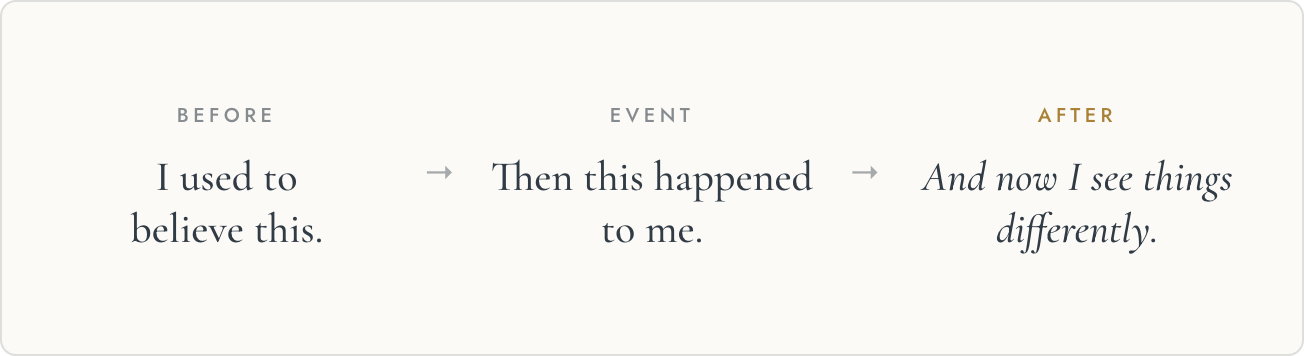
I used to believe this. Then this happened to me. And now I see things differently.
That's a helpful framework to keep in mind when you're trying to understand why a particular experience is worth sharing. Sometimes the transformation is significant. Other times, it's a small realization. And sometimes the story doesn't need an elaborate lesson at all. The experience itself is interesting enough to tell.
The important thing is to give the audience some sense of resolution.
One story at a time.
In the session I described earlier, my client initially wanted to tell a story about struggling with grammar in her thirties. But as we talked, I realized we were actually discussing several different stories.
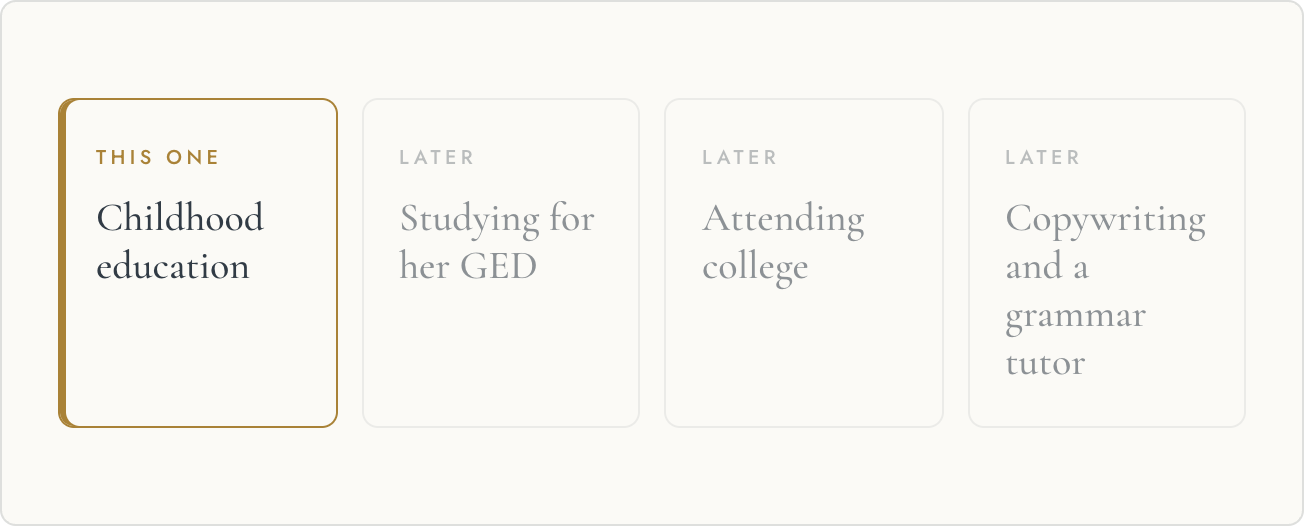
There was the story of her childhood education. The story of studying for her GED. The story of attending college. And the story of eventually working as a copywriter and hiring a tutor to help her learn grammar. Each of those experiences could be an interesting story on its own. And that's what I encouraged her to do.
Rather than trying to condense decades of her life into one piece of content, we focused on one experience and gave it a beginning, middle, and end. This is something I want you to remember when you're thinking about the experiences you could share online. You don't need to tell your entire life story in one Instagram post. You don't need to explain every difficult thing you've ever experienced or every decision that brought you to where you are today.
Start with one moment. One experience. One thing that happened. Then ask yourself what led up to it, what happened next, and what changed as a result.
The simpler, the better.
I think sometimes we make storytelling much more complicated than it needs to be. We're so concerned with coming up with a compelling hook, delivering a profound takeaway, or making sure our story is interesting enough that we forget the most basic part of the process: actually telling people what happened.
And oftentimes, the most compelling opening isn't the one that sounds the most dramatic. It's something as simple as, "When I was ten years old, my parents used to leave a stack of schoolbooks on the kitchen table and tell me they'd be home by three."
That's a sentence you can immediately picture. It makes you curious. You want to know what happened next. And that's really what good storytelling does. It brings people into your world, helps them understand your experiences, and gives them a reason to care about what you're sharing.
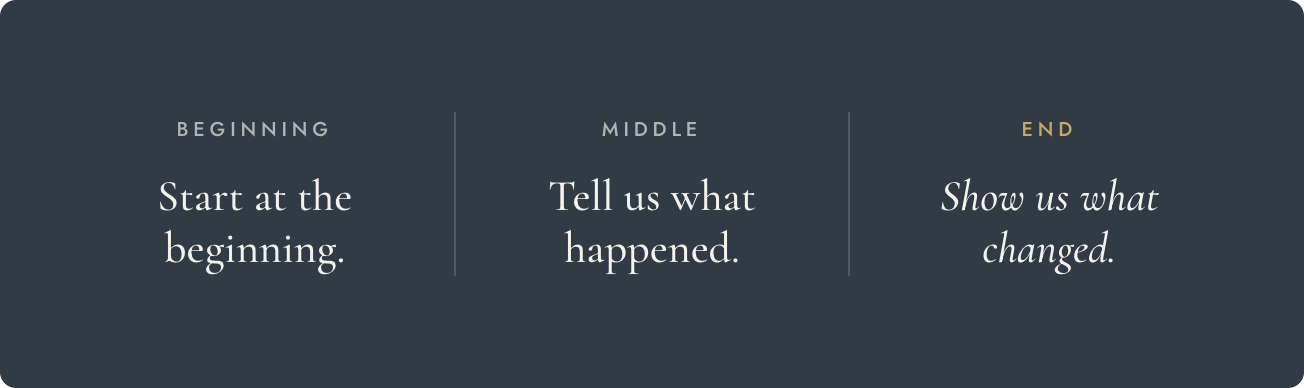
Start at the beginning. Tell us what happened. Show us what changed. You can build from there.
Want a little help putting this into practice?
I've created a free, one-page storytelling guide with the five basic building blocks and simple sentence starters you can use the next time you sit down to write or plan a video.